
- 2 Views
- 6 Min Read
- (0) Comment
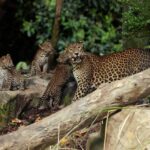
It is one of the most iconic animals on the planet — a solitary, powerful predator that has roamed Sri Lanka’s forests for millennia. The Sri Lankan leopard (Panthera pardus kotiya) is the island’s apex carnivore, a species wrapped in myth and admired by wildlife enthusiasts from across the world. Yet beneath the surface of that celebrated image lies a deeply uncomfortable reality. This animal is under pressure from almost every direction, and the threats are not slowing down.
A detailed analysis by researchers Jacki Yee, Andrew Kittle, and Anjali Watson lays out the full picture — and it is a sobering one.
A Forest That Is Disappearing
The most visible and pervasive threat facing the Sri Lankan leopard is the destruction of the habitats it depends on. Forests that once stretched unbroken from the highlands to the coast are now fragmented by agriculture, urban expansion, roads, resorts, and infrastructure projects. Tea, rubber, and cinnamon plantations have long been replacing forest in the Central and Southern regions, and more recently vegetable farming has extended the agricultural frontier deeper into previously forested areas.
For a species that is solitary and territorial — requiring large, uninterrupted ranges to hunt, mate, and raise young — the shrinking of available land is not merely an inconvenience. It is an existential pressure. As their range contracts, leopards are pushed into marginal areas, closer to human settlements, and the result is predictable: conflict. In the past decade, a significant number of leopard deaths in Sri Lanka have been directly linked to human-leopard encounters in precisely these transition zones.
Isolated and Alone
Fragmentation compounds the problem in ways that go beyond simple space. When forests are broken into isolated patches by roads, paddy fields, and monoculture plantations — as is increasingly happening in provinces like Uva and Sabaragamuwa — leopard populations become genetically cut off from one another. Young leopards, which need to disperse from their birth territories to establish their own ranges, find their natural pathways blocked or lethally dangerous to cross.
The consequences of this isolation accumulate over generations. Reduced genetic exchange leads to inbreeding. Smaller, fragmented patches cannot support sufficient wild prey. Leopards are forced to range further into human-dominated landscapes just to survive. And the protected areas meant to serve as their sanctuaries become, in effect, ecological islands — too small, too isolated, and too disconnected to function as they should.
Research in Wilpattu National Park illustrates this clearly. Leopards there tend to avoid the park’s periphery and retreat toward the core — meaning the park is functionally smaller than its boundaries suggest. This “edge effect” is not unique to Wilpattu. It is a pattern playing out across Sri Lanka’s protected area network.
The Wire in the Forest
Of all the threats documented, snares may be the most quietly devastating. Simple wire loops, cheap to make and almost impossible to detect in the undergrowth, are set across Sri Lanka’s forests in enormous numbers — primarily by farmers protecting their crops from wild boar and hare, and by bush-meat hunters. They make no distinction between target and non-target species.
The research estimates that snares are killing between 8 and 10 leopards every year. Many more are maimed. Deaths from snares are slow and painful — strangulation, infection, starvation — and even animals that survive their injuries are often too compromised to hunt or reproduce effectively. Because snares are illegal and hidden, the true toll is almost certainly undercounted. Every leopard lost to a snare is a loss that the population can ill afford.
Poaching and the Black Market
Beyond snares, deliberate poaching for leopard body parts — teeth, claws, bones, and skin — remains an active, if under-reported, threat. Demand comes from traditional medicine, superstition, and status. Weak law enforcement, limited patrolling, and low conviction rates have allowed this trade to persist largely unchecked.
What makes targeted poaching particularly damaging is that it tends to remove breeding adults — the individuals most critical to population recovery. In a species with already low population numbers, the loss of even a small number of mature animals can send ripple effects through the entire population. The ecological consequences extend beyond the individual: leopards, as apex predators, regulate prey populations and shape the behaviour of species throughout the food chain. Their removal is never a contained event.
When the Prey Disappears
A predator without prey is a predator in crisis. Deforestation reduces the vegetation and cover that wild herbivores — deer, primates, wild boar — need to sustain healthy populations. Free-range cattle grazing in forest areas adds further competition for food and space. When natural prey becomes scarce, leopards turn to livestock, which brings them into direct conflict with farming communities and exposes them to the very real risk of retaliatory killing.
This cycle — habitat loss, prey decline, livestock predation, human conflict, leopard death — is not theoretical. It is already happening, and in multiple locations simultaneously.
The Threads That Connect All of It
What makes the situation so challenging is that none of these threats operate in isolation. Habitat loss drives fragmentation. Fragmentation isolates populations and increases conflict. Conflict raises exposure to snares and retaliatory killing. Prey decline pushes leopards into riskier territory. Each threat amplifies the others, and the combined effect is far greater than any single factor would suggest.
The authors are careful to note that Sri Lanka is not without advantages. The island still has substantial wild prey, reasonable forest cover, a climate that supports natural forest regeneration, and — importantly — a cultural conservation ethic that accepts sharing space with wildlife as normal. These are genuine strengths, and they matter.
But strengths alone are not a strategy. The researchers call for protected areas to be understood not as isolated islands but as nodes in a larger connected ecological network — linked by identified wildlife corridors, supported by strong law enforcement, and sustained by genuine community engagement. Snare removal campaigns need to be scaled up. Buffer zones around protected areas need to be protected and restored. And the political will to treat wildlife corridors as critical infrastructure — as important as the roads that currently fragment them — needs to be built and maintained.
A Leopard Is More Than a Leopard
The Sri Lankan leopard is what ecologists call an umbrella species — an animal whose survival, if genuinely secured, will by necessity protect the wider ecosystem it inhabits. Ensuring the leopard’s future means protecting forests, maintaining prey populations, managing human-wildlife boundaries thoughtfully, and keeping landscapes connected. In doing all of that, we protect far more than one species.
The leopard is still here. That is not something to take for granted.
Based on: Yee, J., Kittle, A. and Watson, A. (2025). A Deep Dive into the Threats Faced by Leopards in Sri Lanka. Sunday Observer, 3 August 2025.
Leave a comment: