
- 12 Views
- 4 Min Read
- (0) Comment
What Does Sri Lanka’s Leopard Actually Eat? The Science Behind the Predator
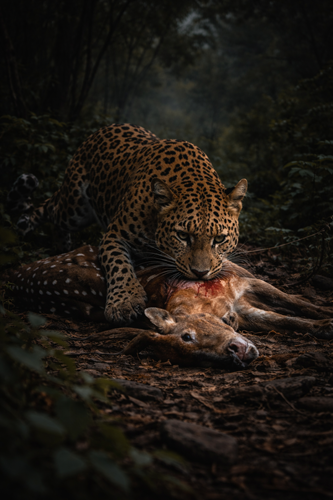
The Sri Lankan leopard (Panthera pardus kotiya) is the island’s apex predator — the top of the food chain, the animal that keeps ecosystems in balance. But how much do we actually know about what it hunts, and what happens when its preferred prey begins to disappear? A study published in the Department of Wildlife Conservation’s journal WildLanka offers some revealing answers — and raises some important questions about the future of this remarkable animal.
The Apex Predator with a Surprisingly Flexible Diet
Most people assume that a large, powerful cat like the Sri Lankan leopard spends its days hunting deer and buffalo. The reality, as revealed by scientific scat analysis carried out in Horton Plains National Park, is considerably more nuanced — and in some ways, more concerning.
Researchers collected and analyzed 82 leopard scat samples across Horton Plains between June and October 2013, identifying prey species by examining hair remains under a microscope. The results were striking. While the Sambar deer (Rusa unicolor) accounted for the largest share of biomass consumed — approximately 81% — the picture of what the leopard was actually hunting on a day-to-day basis was very different. In terms of sheer number of prey individuals, rats (Rattus sp.) accounted for nearly 72% of all successful hunting attempts. The island’s apex predator, in other words, was spending the majority of its hunting time chasing rodents.
Why This Matters: The Concept of “Sub-Optimal” Prey
Leopards globally tend to prefer prey in the 10–40 kg body weight range, with the ideal target sitting at around 25 kg. This is the weight class where the energy gained from a kill most efficiently outweighs the energy spent — and the risk taken — in making it. The Sambar deer, which can weigh well over 200 kg, actually exceeds this preferred range significantly. Rats weigh less than 200 grams.
When a leopard is regularly hunting prey far outside its preferred weight range — both above and below — it is a strong ecological signal. It suggests that the animals it would ideally be targeting simply are not available in sufficient numbers. This behaviour, known as switching to sub-optimal prey, is documented across multiple sites in Sri Lanka: at Peak Wilderness Sanctuary, Haggala, Agarapathana, and Hantana, as well as Horton Plains. In each case, the pattern points to the same underlying problem — a degradation of the natural prey base that the leopard depends on.
A Forest Hunter in a Changing Landscape
The Sri Lankan leopard is fundamentally a forest animal. It hunts by stealth, using dense vegetation for cover, and it preferentially targets prey species that live within forested habitats. This is why spotted deer (Axis axis), despite being common across many parts of Sri Lanka, appear relatively rarely in leopard diet studies — they tend to occupy more open ground and move in larger, more alert herds that provide poor hunting conditions for a solitary ambush predator.
The species most vulnerable to leopard predation tend to be those that live in forest interiors, move in small groups or alone, and lack highly developed collective defence behaviours. When those forest habitats shrink or degrade, these prey species decline — and the leopard’s options narrow accordingly.
The Highland Warning Sign
Perhaps the most significant finding to emerge from comparing multiple study sites is the consistency of the pattern. Across the highlands and wet zone forests of Sri Lanka, research spanning decades shows the same shift: leopards hunting smaller and smaller prey, making more and more attempts for less and less return. The study describes this as a clear signal of habitat quality degradation.
There is a human dimension to this too. When leopard prey populations collapse in a given area, leopards come into contact with livestock and human settlements more frequently. Conflict between leopards and local communities in highland areas has been documented, and the research suggests this is not simply a behavioural quirk of individual animals — it is a predictable consequence of ecosystem imbalance.
Conservation Starts with Understanding
The research makes a compelling case for scat analysis as a practical, low-cost tool for monitoring leopard habitats over time. By tracking what a leopard is eating — and how that changes from year to year — conservationists can assess the health of an ecosystem without ever needing to see the leopard itself. It is a window into the forest, opened through patient, methodical science.
For wildlife enthusiasts visiting Sri Lanka’s national parks and reserves, this is a useful frame through which to observe the landscape. The leopard you might glimpse at dawn is not simply a beautiful animal at the top of a hierarchy — it is an indicator species, a living measure of whether the forest around it is functioning as it should. When the prey is abundant and diverse, the leopard thrives. When it is not, the leopard adapts — and the adaptation itself tells a story worth paying attention to.
Source: Sooriyabandara, M.G.C. (2015). Prey Base Analysis of Sri Lankan Leopard (Panthera pardus kotiya) in Horton Plains National Park and a Review to Past Studies. WildLanka, Vol. 3, No. 2. Department of Wildlife Conservation, Sri Lanka.
Leave a comment: