
- 11 Views
- 19 Min Read
- (0) Comment
A detailed, head-to-head comparison of two of the world’s most remarkable leopard subspecies — one the king of an island, the other the most widespread big cat on Earth
Introduction: Same Species, Two Very Different Worlds
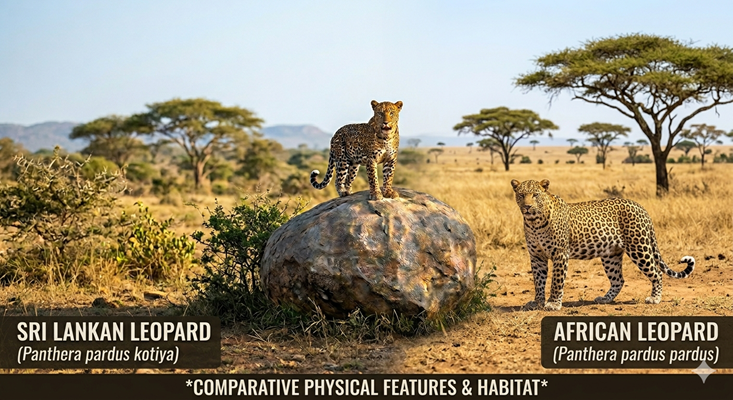
They share the same scientific genus, the same spotted coat, and the same solitary instincts. Yet the Sri Lankan leopard and the African leopard have been shaped by vastly different evolutionary pressures — one confined to a tropical island with no rival predators, the other competing for survival on a continent crowded with lions, hyenas, and wild dogs. The result is two animals that are unmistakably related, yet fascinatingly distinct in size, behaviour, ecology, and conservation outlook.
This article places the two subspecies side by side — examining their physical differences, their hunting strategies, their habitats, their diets, their social lives, and the very different threats they face. Whether you are a wildlife enthusiast, a safari traveller, or simply curious about the natural world, this comparison reveals just how powerfully environment shapes evolution.
At a Glance: Key Facts Side by Side
| Feature | Sri Lankan Leopard | African Leopard |
|---|---|---|
| Scientific Name | Panthera pardus kotiya | Panthera pardus pardus |
| First Described | 1956, by P.E.P. Deraniyagala | 1758, by Carl Linnaeus |
| IUCN Status | Vulnerable | Vulnerable |
| Range | Sri Lanka only (endemic) | Sub-Saharan Africa; fragments in North Africa |
| Male Weight | ~56 kg; up to 77 kg (possibly ~100 kg) | ~60–90 kg; up to 90 kg |
| Female Weight | ~29 kg average | ~30–60 kg |
| Coat Colour | Tawny or rusty yellow | Pale yellow to deep gold or tawny |
| Rosette Shape | Smaller, close-set rosettes | Circular (East Africa); squarish (South Africa) |
| Tree Hoisting Kills | Rarely — no competing predators | Regularly — essential to avoid lions and hyenas |
| Activity Pattern | Nocturnal and diurnal | Predominantly nocturnal |
| Apex Predator? | Yes — sole apex predator of Sri Lanka | No — competes with lions, hyenas, wild dogs |
| Estimated Population | 700–950 mature individuals | Declining; no reliable continent-wide count |
| Gestation Period | 90–105 days | 90–105 days |
| Lifespan (Wild) | 12–15 years | 10–15 years |
1. Taxonomy and Classification
Both the Sri Lankan leopard and the African leopard belong to the species Panthera pardus — the leopard — but they are distinct subspecies shaped by millions of years of geographic separation.
The African leopard (Panthera pardus pardus) is the nominate subspecies — the original from which the species itself takes its name. It was first formally described by Carl Linnaeus in 1758. All continental African leopards are considered to belong to this single subspecies, making it genetically and geographically the broadest of the nine recognised forms. Recent studies have identified multiple mitochondrial lineages within the African population, suggesting deep internal diversity, but all are grouped under the single subspecies designation.
The Sri Lankan leopard (Panthera pardus kotiya) is a far more recently described subspecies, formally named in 1956 by Sri Lankan zoologist Paules Edward Pieris Deraniyagala. The name kotiya derives from the Sinhala word for leopard. Genetic analysis confirms it as a distinct evolutionary lineage, having been isolated on the island of Sri Lanka for hundreds of thousands of years — long enough to develop measurable physical and behavioural differences from its mainland relatives.
Out of the nine subspecies, the African and Arabian leopards are considered the oldest and most genetically divergent. The Sri Lankan subspecies branched from the Asian lineage and is genetically most closely related to the Indian leopard, though it has diverged significantly due to island isolation.
2. Physical Appearance
Size and Build
This is where one of the most striking differences between the two subspecies emerges — and where island evolution has produced something truly remarkable.
The African leopard is a large, powerful animal. Adult male African leopards typically weigh between 60 to 90 kilograms, while females typically range from 30 to 60 kilograms. They have a body length of approximately 1.5 to 2.5 metres, with a tail adding another 60 to 100 centimetres.
The Sri Lankan leopard, despite being an island subspecies — which one might expect to be smaller — has gone in the opposite direction. With no competition from other large cats like lions or tigers, the leopards found in Sri Lanka have become the largest leopards in the world. Males average 56 kg, with the largest individuals recorded at 77 kg and measuring up to 1.42 m in body length with a 97 cm tail. Large males have been suggested to reach almost 100 kg, though evidence for this is lacking.
This phenomenon — where an island predator grows larger due to the absence of competition — is sometimes referred to as competitive release. With no lions or tigers to worry about, Sri Lankan leopards could afford to grow bigger, bolder, and more conspicuous than their relatives elsewhere in Asia or Africa.
Coat and Rosette Pattern
Both subspecies carry the iconic spotted coat that makes leopards instantly recognisable, but the details differ meaningfully.
The African leopard’s rosettes are circular in East African populations and tend to be squarish in Southern African populations. The fur tends to be grayish in colder climates and dark golden in rainforest habitats. African leopards in open savannah tend toward a warm, rich gold, while those in forested or mountainous areas are often darker.
The Sri Lankan leopard has a tawny or rusty yellow coat with dark spots and close-set rosettes, which are smaller than in Indian leopards. The overall impression is of a slightly more compact rosette pattern compared to the broader, more widely spaced rosettes seen on many African individuals — though both patterns are entirely unique to each individual animal.
In both subspecies, melanistic individuals — commonly known as black panthers — can occur, though they are rare. In Sri Lanka, few records of melanistic individuals exist. In October 2019, the Department of Wildlife Conservation recorded live footage of a melanistic Sri Lankan leopard for the first time. In Africa, melanism is also rare in open savannah populations but more common in certain forest environments.
3. Habitat
The African Leopard: Master of Every Terrain
The African leopard occupies one of the most diverse habitat ranges of any wild cat on Earth. African leopards can be found in a wide range of habitats across sub-Saharan Africa, from the rainforests of West and Central Africa to the arid landscapes of the Kalahari and Sahara deserts. They also inhabit savannahs, woodlands, grasslands, mountainous landscapes, and coastal scrublands.
The preferred habitat across much of their range is dense bush and riverine forest — areas that provide both cover for hunting and trees for storing kills and resting. They have been recorded at elevations exceeding 5,200 metres on Kilimanjaro and have been observed living on the fringes of major cities. This extraordinary breadth of habitat use is central to the African leopard’s status as the most widespread wild cat on Earth.
However, this adaptability comes with a caveat. The leopard’s range in West Africa is estimated to have drastically declined by 95%, and in the Sahara desert by 97%. In sub-Saharan Africa, it is still numerous and surviving in marginal habitats where other large cats have disappeared.
The Sri Lankan Leopard: Every Corner of an Island
The Sri Lankan leopard, though confined to a single island of approximately 65,610 km², has demonstrated its own impressive habitat versatility. Leopards have been observed to use nearly all terrestrial habitats on Sri Lanka and are equally at home in the dry scrub forest as in the dense rainforest, and from sea level to the montane cloud forests.
In Sri Lanka’s central hills, leopards have been recorded in forest patches, tea estates, grasslands, home gardens, and pine and eucalyptus plantations. This willingness to occupy human-modified landscapes is both a sign of adaptability and a source of conflict, as leopards in tea estates and agricultural zones come into increasing contact with people and livestock.
The key strongholds are Yala National Park in the dry southeast — which boasts one of the highest recorded leopard densities in the world — and Wilpattu National Park in the northwest, along with Wasgamuwa and Horton Plains in the central highlands.
4. Hunting Behaviour
The African Leopard: Stealth Under Pressure
The African leopard is a consummate ambush predator, but one that must operate under constant competitive pressure from larger carnivores. Leopards are primarily nocturnal, doing most of their hunting at night — partly because this reduces confrontations with larger predators such as lions and hyenas.
Ambush tactics are a hallmark of leopard hunting. They often position themselves in dense foliage or on tree branches, launching sudden attacks from above or the side. Once prey is subdued, they frequently drag their kills up into trees to avoid scavengers and consume in safety. This tree-hoisting behaviour is perhaps the most iconic hallmark of the African leopard — a direct adaptation to life alongside lions and spotted hyenas, which would otherwise steal every kill.
Lions pose a great mortal threat to leopards and can be responsible for 22% of leopard deaths in some reserves. Spotted hyenas are more likely to steal kills, being responsible for up to 50% of stolen leopard kills in some study areas. To counter this, leopards store their kills in trees out of reach — though lions have a high success rate in fetching kills even from trees.
Researchers believe that each individual African leopard accounts for approximately 20 kills per year, consuming on average about a third of each carcass — roughly 400 kg of meat per leopard annually.
The Sri Lankan Leopard: Hunting Without Fear
The Sri Lankan leopard hunts in a fundamentally different context. With no lions, hyenas, wild dogs, or tigers on the island, it faces no serious competition for kills and no mortal threat from rival predators of comparable size. The consequences for its behaviour are profound.
Sri Lankan leopards do not usually store their kills in trees, perhaps because similarly-sized or larger carnivores are absent in Sri Lanka. This is one of the clearest behavioural distinctions between the two subspecies — a habit that is essential to survival in Africa but entirely unnecessary in Sri Lanka.
In Sri Lanka, the leopard is the top predator and can be observed in its habitat during most times of the day, whereas in other parts of the world such as India and Africa, it is almost exclusively nocturnal due to the presence of even larger carnivores. This greater daytime activity makes the Sri Lankan leopard considerably more visible to wildlife observers than its African counterpart — a major reason why Yala National Park is considered one of the best places in the world to see leopards.
Sri Lankan leopards are primarily nocturnal ambush hunters, targeting prey as large as water buffalo. As the island’s top land predator, leopards will eat nearly anything they come across, including monkeys, birds, reptiles, all species of deer, and even buffalo calves that are generally larger than themselves.
5. Diet
African Leopard: The Opportunist
The African leopard has one of the most diverse diets of any large carnivore. African leopards are opportunistic feeders with a highly variable diet that includes over 90 prey species. Small and medium-sized ungulates such as antelopes, gazelles, and impalas make up their primary victims; however, when needed, they target small mammals, birds, and even insects. Leopards can kill animals weighing as much as three times greater than their own body weight.
In different parts of Africa, prey preferences vary significantly. In the Serengeti and Kruger, impala are the most commonly taken prey. In West African forests, smaller mammals and primates dominate the diet. In some coastal areas, fish have been recorded as prey. This dietary flexibility is a key reason the African leopard has survived in such a wide range of environments.
The African leopard must also contend with kleptoparasitism — the theft of its kills by larger predators. In areas where predators are abundant, leopards will often hoist their kills to avoid them being stolen by larger, stronger predators.
Sri Lankan Leopard: The Island Generalist
The Sri Lankan leopard’s diet reflects both its island environment and its apex status. Sri Lankan axis deer make up the majority of its diet in the dry zone. The animal also preys on sambar, barking deer, wild boar, and monkeys. Like most cats, it is pragmatic in its choice of diet, which can include small mammals, birds, and reptiles, as well as larger animals. Scat analysis has also revealed evidence of crabs, frogs, and other small vertebrates — showing the same opportunistic flexibility seen in the African subspecies.
Importantly, because the Sri Lankan leopard faces no competition from other large carnivores, it can take the full range of available prey without the risk of losing kills to rivals. It can feed on the ground at its leisure and take large prey — including buffalo calves and sambar stags — that would be more challenging for a leopard operating in Africa under constant competitive pressure.
6. Social Structure and Behaviour
In both subspecies, the fundamental social structure is the same: solitary, territorial, and largely nocturnal. Both are polygynandrous — meaning both males and females mate with multiple partners. Both raise cubs without paternal involvement. And in both, territory size and overlap follow the same general pattern: male territories are larger and overlap with those of multiple females.
Males possess large territories that may overlap with those of several females but are aggressively defended against other males. Leopards communicate their territorial boundaries through scent marking, vocalisations, and scratching on trees.
However, the degree of daytime visibility differs markedly. In Sri Lanka, leopards are commonly seen hunting during daylight hours as well as at night. In Africa, the presence of lions and hyenas forces leopards to be almost exclusively nocturnal and secretive — in such areas the cats become extremely secretive and more often than not are never seen except for the pug marks and scats they leave behind.
In Yala National Park, the Sri Lankan leopard is a solitary hunter, with the exception of females with young. Male’s ranges typically overlap the smaller ranges of several females, as well as portions of the ranges of neighbouring males, although exclusive core areas are apparent. This mirrors African leopard social structure closely, confirming that the fundamental organisation of leopard society is conserved across subspecies, even where the ecological context differs dramatically.
Reproduction is also broadly similar. Both subspecies have a gestation period of 90 to 105 days and give birth to litters of two to four cubs. No birth season or peak is apparent in Sri Lanka, with births occurring across the year. The same is true of the African subspecies. Cubs in both subspecies remain with their mother for 18 to 24 months, learning essential hunting and survival skills before dispersing to establish their own territories.
7. Predator Competition and Ecosystem Role
This is perhaps the most fundamental ecological difference between the two subspecies — and the one that drives most of the behavioural distinctions discussed above.
The African leopard lives within a complex predator guild. In Africa, the leopard coexists with lions, cheetahs, spotted and brown hyenas, and African wild dogs. The leopard is dominant only over the cheetah, while the others have the advantage of size, pack numbers, or both. This means the African leopard is constantly managing threats — from kill theft, from direct predation, and from competitive displacement. It must be nocturnal to avoid confrontations. It must hoist kills. It must choose hunting locations carefully. Its entire lifestyle is shaped by the presence of these competitors.
The Sri Lankan leopard, by contrast, operates in a predator vacuum. As it is an apex predator in the ecological pyramid due to the absence of other larger predators, it has evolved to be a rather large subspecies. It sets the terms for every interaction in its ecosystem. It can hunt when it chooses, feed where it chooses, and grow to sizes that would be disadvantageous in more competitive environments. Its ecological role is also broader — controlling populations of deer, wild boar, monkeys, and other prey species across the entire island without any counterbalancing pressure from rival predators.
8. Visibility and Wildlife Tourism
For wildlife enthusiasts and safari travellers, this comparison has a very practical dimension: where are you more likely to actually see a leopard?
African leopards, despite being found across a vast continent, are notoriously difficult to observe. Their predominantly nocturnal habits, their instinct to retreat from competing predators and from humans, and the sheer density of vegetation in many of their habitats make sightings unpredictable. The best locations for leopard sightings in Africa include South Luangwa National Park in Zambia, the Sabi Sands and Greater Kruger ecosystem in South Africa, the Serengeti in Tanzania, and the Maasai Mara in Kenya — places where open terrain and high leopard densities improve the odds.
The Sri Lankan leopard, by contrast, is considered among the easiest leopards in the world to observe in the wild. In Sri Lanka, the leopard can be observed in its habitat during most times of the day, unlike in Africa where it is almost exclusively nocturnal. It is infinitely easier to see a leopard in Sri Lanka than it is in India, especially in Yala and Wilpattu. Sri Lankan leopards are usually bigger and more powerful than their Indian counterparts. They regularly take down big prey like sambar stags and young buffalo.
In 2001 to 2002, adult resident leopard density was estimated at 12.1 mature individuals and 21.7 individuals of all ages per 100 km² in Block I of Yala National Park — one of the highest recorded densities for any leopard subspecies in the world.
9. Conservation Status and Threats
African Leopard
The African leopard is listed as Vulnerable on the IUCN Red List, a status that reflects a broad, continent-wide decline that is difficult to quantify precisely because no reliable population count exists for the entire continent.
The primary threats are habitat loss and fragmentation due to agricultural expansion, the bushmeat trade depleting prey populations, retaliatory killing over livestock predation, poaching for skins and body parts, and in some countries poorly managed trophy hunting. Habitat loss is occurring at an alarming rate: since 2016, their range has declined by 11%, with significant losses in Africa, the Middle East, and Southeast Asia. In West Africa, the situation is particularly severe, with leopards now functionally absent from large parts of their former range.
Conservation efforts across Africa include anti-poaching enforcement, community-based livestock protection programmes (such as predator-proof bomas), GPS collar research programmes, and large-scale transfrontier conservation areas that allow leopards to maintain viable populations across national borders. Key organisations include the African Wildlife Foundation, Panthera, and WWF.
Sri Lankan Leopard
The Sri Lankan leopard is also listed as Vulnerable on the IUCN Red List, with a population estimated at 700 to 950 mature individuals that is probably declining. The survival of the Sri Lankan leopard is primarily threatened by increasing habitat loss and fragmentation, together with an increasing risk of human-induced mortality. Since 2010, over 90 leopards are known to have been killed by people in Sri Lanka.
Wire snares set for wild boar and deer claim leopard lives accidentally. Retaliatory poisoning following livestock predation is a significant source of mortality. Habitat fragmentation — particularly in the central highlands where tea estates and development have disrupted leopard corridors — is accelerating. The illegal trade in leopard canine teeth, worn as talismans, adds further poaching pressure.
On the positive side, Sri Lanka has a relatively strong conservation infrastructure and a cultural tradition — rooted in Buddhist and Hindu values — of respect for wildlife. The Wilderness and Wildlife Conservation Trust (WWCT), led by researchers Anjali Watson and Dr. Andrew Kittle, has conducted over two decades of field research through the Leopard Project, generating the data needed to guide effective policy. Sri Lanka’s Department of Wildlife Conservation manages an extensive network of national parks and sanctuaries that provide protected habitat for the subspecies.
10. Cultural Significance
Both subspecies have deep cultural resonance in their respective regions.
The African leopard has featured in the art, mythology, and ceremonial life of African societies for thousands of years. Leopard skins were worn by kings and warriors as symbols of power and courage. In ancient Egypt, leopard-skin garments were worn by priests at funerary ceremonies. Across West Africa, the leopard appears as a symbol of royalty and spiritual authority. Today it remains one of the most sought-after wildlife sightings on an African safari — a totemic animal for the continent’s tourism industry.
The Sri Lankan leopard — known as the kotiya in Sinhala and siruththai in Tamil — is deeply woven into the cultural identity of Sri Lanka. It is the island’s apex predator and its most iconic wild animal. Unlike elephants, which appear on the national flag and are central to religious and cultural ceremonies, the leopard maintains a wild, untamed mystique. It is revered as a forest guardian in local folklore and is a source of tremendous national pride. Sri Lankan Leopard Day, observed on 1st August each year since 2021, celebrates the subspecies and raises public awareness of its conservation.
Summary: Key Differences and Similarities
Where they differ most: The most fundamental difference is ecological context. The Sri Lankan leopard is a sole apex predator operating without competition. The African leopard lives under constant pressure from lions, hyenas, and wild dogs. This single difference drives most of the behavioural distinctions — tree hoisting, nocturnal habits, size, and boldness — between the two subspecies.
Where they are most similar: At the level of fundamental biology, the two subspecies are closely matched. Both are solitary, territorial, opportunistic hunters with broad diets, 90 to 105-day gestation periods, similar lifespans, and the same basic social organisation. Their shared ancestry is evident in everything from their coat patterns to their parenting behaviour.
Which is bigger? The Sri Lankan leopard — particularly males — is widely regarded as one of the largest leopard subspecies in Asia, and arguably one of the largest anywhere. The absence of competing predators has allowed it to grow larger than most of its relatives, including the average African leopard, though the largest African males (up to 90 kg) can exceed the typical Sri Lankan male.
Which is easier to see? The Sri Lankan leopard, without question. Its daytime activity, high density in Yala and Wilpattu, and lack of competing predators that force concealment make it the most observable leopard subspecies in the world.
The Sri Lankan leopard and the African leopard are a study in how the same animal — given different environments, different competitors, and different evolutionary pressures — can become something subtly but meaningfully distinct. One stalks the open savannahs and dense forests of a vast continent, perpetually looking over its shoulder for lions and hyenas. The other prowls through the jungles and scrublands of a tropical island, unchallenged and unhurried, the uncrown king of everything it surveys.
Both face a future that is uncertain. Both are classified as Vulnerable. Both are losing ground to habitat loss, human-wildlife conflict, and the relentless expansion of human activity. But both also have passionate communities of conservationists, researchers, and local people working to ensure their survival.
To support their conservation, visit the Wilderness and Wildlife Conservation Trust (WWCT) for Sri Lanka, and Panthera and the African Wildlife Foundation for Africa.
References and Further Reading
- Wikipedia. Sri Lankan Leopard (Panthera pardus kotiya).
- Wikipedia. African Leopard (Panthera pardus pardus).
- Wikipedia. Leopard (Panthera pardus).
- IUCN Cat Specialist Group. Living Species — Leopard.
- Stein, A.B. et al. (2024). Panthera pardus. The IUCN Red List of Threatened Species.
- Natural Habitat Adventures. Sri Lankan Leopard Facts — Sri Lanka Wildlife Guide.
- African Wildlife Foundation. African Leopard Conservation.
- IFAW. Leopard Facts: Habitat, Threats and Conservation.
- San Diego Zoo Wildlife Alliance Library. Leopard (Panthera pardus) Fact Sheet — Behaviour and Ecology.
- Wilderness and Wildlife Conservation Trust. The Leopard Project — Sri Lanka.
- Wildlife SOS. The Nine Lives of a Big Cat — Leopard Subspecies.
- Kruger National Park. Facts About Leopards — Kruger National Park.
Leave a comment: