
- 50 Views
- 16 Min Read
- (0) Comment
A comprehensive guide to one of Earth’s most widespread and diverse wild cats — from the forests of Africa to the mountains of Russia, and the jungles of Sri Lanka
Introduction: One Species, Many Worlds
The leopard is, by almost any measure, the most successful of the big cats. It ranges further than the lion, survives in harsher conditions than the tiger, and outlasts almost every environmental challenge thrown at it. Its secret is adaptability — an almost unparalleled ability to live in deserts and rainforests, mountains and grasslands, remote wilderness and the fringes of human cities.
The leopard has the largest distribution of all wild cats, occurring widely in Africa and Asia. It inhabits foremost savanna and rainforest, and areas where grasslands, woodlands, and riparian forests remain largely undisturbed. It also persists in urban environments, if it is not persecuted, has sufficient prey, and patches of vegetation for shelter during the day.
Yet within this single, remarkably successful species, evolution has crafted remarkable diversity. Isolated by oceans, mountain ranges, and vast distances over thousands of years, different leopard populations developed their own distinct identities — different in size, coat colour, behaviour, and ecology. The result is a family of subspecies that tells the story of the leopard’s extraordinary journey across the globe.
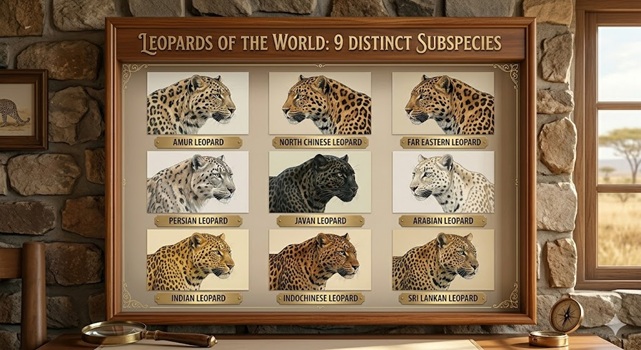
Today, scientists recognise either eight or nine valid subspecies of leopard, depending on which classification system is used. Following Linnaeus’ first description, 27 leopard subspecies were proposed by naturalists between 1794 and 1956. Since 1996, only eight subspecies have been considered valid on the basis of mitochondrial analysis, with later analysis revealing a ninth valid subspecies, the Arabian leopard.
This article explores every one of them — who they are, where they live, what makes them unique, and what threatens their survival.
The Leopard at a Glance
Before meeting the subspecies, it helps to understand the species as a whole.
Male leopards typically weigh between 37 to 90 kg, while females weigh around 28 to 60 kg. Their body length ranges from 91 to 191 cm, with a tail length of 58 to 110 cm. The leopard’s coat features rosettes — small black spots surrounding a central spot slightly darker than the background colour. The background colour itself can be pale cream, buff-gray, orangish, tawny-brown, or dark rufous.
The fur tends to be grayish in colder climates and dark golden in rainforest habitats. Rosette patterns are unique to each individual — thought to be an adaptation to dense vegetation with patchy shadows, where the coat serves as camouflage. Rosettes are circular in East African leopard populations, squarish in Southern African populations, and larger in Asian leopard populations.
As a species, the leopard is listed as Vulnerable on the IUCN Red List. The leopard now occupies just 25–37% of its historic range. Of the nine recognised subspecies, three — the African, Indian, and Persian — account for 97% of the leopard’s remaining range, while three others — the Amur, Arabian, and North Chinese — have each lost as much as 98% of their historic range.
The 8 (or 9) Subspecies of Leopard
1. The African Leopard (Panthera pardus pardus) — The Nominate Subspecies
Conservation Status: Vulnerable
Range: Sub-Saharan Africa, with fragmented populations in North Africa
Estimated Population: Declining across much of its range; no reliable continent-wide count
The African leopard is the nominate subspecies — the one from which the entire species takes its scientific name. It is the most widespread of all the subspecies, found across most of sub-Saharan Africa and historically ranging into North Africa as well. Its coat colour varies from pale yellow to deep gold or tawny, and sometimes black, and is patterned with black rosettes, while the head, lower limbs, and belly are spotted with solid black.
The most common habitat occupied by African leopards is the open woodland and grassland savanna mosaic of East and Southern Africa, where they occur in their highest densities. However, leopards also occupy a variety of other habitats, from moist tropical forests in Central Africa to arid semi-desert regions.
African leopards are exceptional hunters. They take prey ranging from small rodents to large antelope, and are well known for hauling kills into trees to protect them from lions and hyenas. Pound for pound, the leopard is the strongest climber of all the big cats — their shoulder blades have special attachment sites for stronger climbing muscles.
Despite being the most numerous subspecies, the African leopard faces mounting pressure. Due to habitat fragmentation and loss, the leopard’s range has reduced by 31 percent worldwide in the past three generations. The commercialised bushmeat trade has caused a collapse of prey populations across large parts of savanna Africa — an estimated 59 percent decline across 78 protected areas. Habitat conversion and persecution in retribution for livestock loss are the major ongoing threats.
Learn more: African Wildlife Foundation — Leopard
2. The Indian Leopard (Panthera pardus fusca) — The Survivor of South Asia
Conservation Status: Vulnerable (Near Threatened in some assessments)
Range: Indian subcontinent, including India, Nepal, Bhutan, Bangladesh, and parts of Myanmar and China
Estimated Population: Approximately 12,000–15,000 in India alone
The Indian leopard is the most numerous Asian subspecies and arguably the most studied leopard on Earth outside of Africa. It is a remarkable urban survivor — populations are known to live in close proximity to major Indian cities, navigating fragmented forest patches, tea gardens, and agricultural landscapes with impressive adaptability.
In the Indian subcontinent, the leopard is still relatively abundant, with greater numbers than those of other Panthera species. Some leopard populations in India live quite close to human settlements and even in semi-developed areas. As of 2020, the leopard population within forested habitats in India’s tiger range landscapes was estimated at 12,172 to 13,535 individuals.
Indian leopards are large and powerful, with males in some regions rivalling tigers in ambition if not size. They are primarily nocturnal and secretive, but their presence in human-dominated landscapes has led to frequent conflict, especially when leopards prey on livestock. Between 2002 and 2012, at least four leopards were estimated to have been poached per week in India for the illegal wildlife trade of skins and bones.
Learn more: Panthera — Leopard Conservation
3. The Persian Leopard (Panthera pardus tulliana) — The Mountain Giant
Conservation Status: Endangered
Range: Turkey, Caucasus region (Georgia, Armenia, Azerbaijan), Iran, Iraq, Afghanistan, Pakistan, Turkmenistan, and Uzbekistan
Estimated Population: 800–1,290 mature individuals
The Persian leopard — also known as the Caucasian leopard or Anatolian leopard — is the largest of all leopard subspecies. Males can weigh up to 90 kg, making them comparable in bulk to some tigers. It inhabits rugged, mountainous terrain across a vast swathe of Southwest and Central Asia — rocky ridges, forested mountain slopes, and upland steppes — where it is rarely encountered by humans despite its enormous size.
According to the IUCN, the Persian leopard is classified as Endangered, with only about 871 to 1,290 mature individuals reported to exist. In Iran, a study conducted between 2007 and 2011 revealed that nearly 70% of Persian leopard mortalities were due to illegal hunting and poisoning, with road accidents accounting for a further 18% of deaths.
The Persian leopard occupies a politically fragmented range, crossing through countries with varying levels of wildlife protection and enforcement. This makes coordinated conservation deeply challenging. Prey depletion, particularly of wild goats and mouflon, is a significant problem — when natural prey is scarce, leopards turn to livestock, triggering retaliatory killings. Reintroduction programmes have been launched in parts of Russia and the greater Caucasus region.
Learn more: Panthera — Leopard Conservation
4. The Arabian Leopard (Panthera pardus nimr) — On the Edge of Extinction
Conservation Status: Critically Endangered
Range: Restricted fragments of the Arabian Peninsula — primarily Oman, Yemen, and possibly the United Arab Emirates and Israel
Estimated Population: 45–200 individuals; some estimates suggest fewer than 100 remain
The Arabian leopard is the smallest leopard subspecies and one of the most endangered mammals on Earth. Once distributed across the entire Arabian Peninsula, including parts of the Sinai Peninsula in Egypt, it has been reduced to a handful of tiny, isolated populations clinging to survival in remote mountain ranges.
Its pale, sandy-grey coat is an adaptation to the arid rocky terrain it inhabits. Despite being the smallest leopard, it sits at the apex of its desert ecosystem — the largest predator in the region. These predators feed on Arabian gazelles, Cape hare, rock hyrax, Nubian ibex, and other native mammals.
The Arabian subspecies is limited to an estimated 100–250 individuals distributed across just 2% of their historic habitat. No Arabian leopards remain in Saudi Arabia. Its populations are severely fragmented, meaning the animals rarely encounter one another — a serious problem for breeding. Poaching, prey depletion, and habitat destruction have all accelerated the collapse.
Captive breeding programmes — particularly in Oman and the UAE — represent one of the last lifelines for this subspecies. Without urgent, sustained intervention, the Arabian leopard faces extinction within decades.
Learn more: IUCN Red List — Arabian Leopard
5. The Javan Leopard (Panthera pardus melas) — Java’s Last Big Cat
Conservation Status: Endangered
Range: The island of Java, Indonesia
Estimated Population: Approximately 250–600 individuals, declining
The Javan leopard is the sole large predator remaining on Java — one of the most densely populated islands in the world, home to over 150 million people. That it survives at all is remarkable. That its survival remains deeply uncertain is unsurprising.
Endemic to Java, this subspecies has adapted to the island’s remaining forest fragments, including the montane forests of Gunung Halimun-Salak, Gunung Gede-Pangrango, and Baluran National Parks. Melanism is quite common among Javan leopards — black leopards, commonly called black panthers, are relatively frequently observed here, where the dark coat provides an advantage in the dense, shadowy forest.
Java has lost an enormous proportion of its original forest cover to agriculture, plantation development, and urbanisation. Only about 250 mature individuals survive in protected habitats, and their numbers are declining due to depletion of the prey base, poaching, habitat loss, and conflict with humans.
Learn more: WWF — Wildlife Conservation
6. The Indochinese Leopard (Panthera pardus delacouri) — A Quiet Crisis
Conservation Status: Critically Endangered
Range: Myanmar, Thailand, Peninsular Malaysia, Cambodia, and southern China
Estimated Population: 77–766 mature individuals
The Indochinese leopard is one of the least-known and most rapidly declining large cats in Asia. Inhabiting the forests of mainland Southeast Asia and southern China, it has suffered catastrophic range losses in recent decades — a collapse so severe and so poorly documented that it constitutes one of the quiet conservation crises of our time.
The historical range of the Indochinese leopard has decreased by more than 90%. As of 2019, estimates suggest just 77 to 766 mature individuals remain, and their numbers are continuing to decrease. The enormous uncertainty in these figures reflects how little is actually known about the subspecies — camera trap studies are sparse, and much of its potential range is politically difficult to access.
South of the Kra Isthmus in peninsular Malaysia, only melanistic (black) leopards have been recorded in camera traps. Melanism is common in the dense tropical forest habitat here, where it provides a selective advantage for ambush. The stronghold of this subspecies today includes peninsular Malaysia and Thailand, with a small isolated population identified in eastern Cambodia.
Poaching is the primary driver of the Indochinese leopard’s decline — not just of the leopards themselves, but of the prey species they depend on. Wire snares set across Southeast Asian forests strip ecosystems of deer and pigs, leaving leopards without food regardless of how much habitat remains.
Learn more: Panthera’s Leopard Programme
7. The North Chinese Leopard (Panthera pardus japonensis) — The Mountain Cat of China
Conservation Status: Endangered
Range: Northern China, primarily in the Loess Plateau and surrounding mountain ranges
Estimated Population: 174–348 individuals
The North Chinese leopard is one of the most geographically restricted leopard subspecies outside the island-endemic forms. Found in the rugged, semi-arid mountains of northern China — including the Taihang, Lüliangshan, and Qinling mountain ranges — it inhabits a landscape that has been profoundly transformed by thousands of years of intensive human settlement and agriculture.
North Chinese leopards wear a tan coat, as opposed to the Amur leopard’s yellow-ochre fur, reflecting the drier, more open habitats of the Chinese interior. The estimated total population is just 174 to 348 individuals, making it one of the rarest wild cats in the world.
The subspecies faces severe threats from habitat fragmentation, depletion of prey species, and persecution by farmers protecting livestock. Conservation efforts have increased in recent years, partly driven by China’s growing commitment to biodiversity protection and the establishment of large national parks. However, the isolated, fragmented nature of remaining populations makes recovery slow and uncertain.
8. The Amur Leopard (Panthera pardus orientalis) — Back from the Brink
Conservation Status: Critically Endangered
Range: Southwestern Primorye region of Russia and adjacent areas of northeastern China
Estimated Population: Approximately 128–130 mature individuals in Russia; additional individuals in China
The Amur leopard is the world’s rarest big cat. For much of the late 20th and early 21st century, it appeared to be on an irreversible slide toward extinction. In 2007, estimates suggested as few as 19 to 26 individuals survived in the wild. The story since then — while still deeply serious — has become one of the most remarkable conservation recoveries among large carnivores.
Wild Amur leopard numbers have increased to around 130 adults in Russia and northeast China. Their unique coat, with widely spaced rosettes on a pale background, can grow up to 7 cm long during the harsh Russian winter — an adaptation to one of the coldest habitats occupied by any leopard subspecies.
The recovery is largely the result of concerted international conservation work, most notably the creation of Russia’s Land of the Leopard National Park in 2012, which provided a legally protected core habitat. In early 2024, conservationists set up 130 hidden cameras across the park. After three months, the cameras had captured nearly 1,000 images of Amur leopards — identifying 28 individual animals, up from just 16 in 2015. This represents the highest recorded population density in a decade of monitoring.
Despite the good news, the Amur leopard remains extremely fragile. Its tiny population makes it highly vulnerable to canine distemper virus and to the genetic problems caused by inbreeding. The establishment of a second, separate wild population through reintroduction of captive-bred animals is now a key conservation goal.
Learn more: WWF — Amur Leopard | WildCats Conservation Alliance
9. The Sri Lankan Leopard (Panthera pardus kotiya) — The Island King
Conservation Status: Vulnerable
Range: Sri Lanka (endemic — found nowhere else on Earth)
Estimated Population: 700–950 mature individuals
First formally described in 1956 by Sri Lankan zoologist Paules Edward Pieris Deraniyagala, the Sri Lankan leopard occupies a unique ecological position that sets it apart from every other subspecies. It is Sri Lanka’s sole apex predator — there are no lions, no tigers, no wolves or wild dogs on the island. The leopard alone sits at the top of the food chain, and this singular status has shaped it profoundly over millions of years of isolation.
With no competition from other large cats, the Sri Lankan leopard has evolved to become one of the largest leopard subspecies in the world. Unlike most other subspecies, it rarely carries kills into trees — there is simply no competing predator to steal from. Males average around 56 kg, with the largest individuals recorded at 77 kg and measuring up to 1.42 metres in body length.
The Sri Lankan leopard has been observed in virtually every habitat type on the island — dry evergreen monsoon forest, arid scrub jungle, highland forest, rainforest, and wet zone intermediate forests. Yala National Park in the southeast is one of the most famous leopard-watching destinations in the world, boasting one of the highest recorded leopard densities anywhere on Earth.
Since 2020, the Sri Lankan leopard has been listed as Vulnerable on the IUCN Red List, with the population estimated at fewer than 800 mature individuals and probably declining. Since 2010, over 90 leopards are known to have been killed by people in Sri Lanka. The primary threats are habitat loss and fragmentation — particularly in the central highlands — as well as human-wildlife conflict and wire snares.
Sri Lanka’s deep cultural tradition of coexistence with wildlife, rooted in Buddhist and Hindu values, gives this subspecies a societal foundation for protection that many others lack. Conservation is actively supported by the Wilderness and Wildlife Conservation Trust (WWCT) and Sri Lanka’s Department of Wildlife Conservation.
The 8 vs 9 Debate: Why the Numbers Differ
The ambiguity in the article’s title reflects an ongoing and genuinely unresolved scientific debate. In 2017, the Cat Classification Task Force of the Cat Specialist Group recognised eight subspecies as valid taxa, subsuming the North Chinese leopard into the broader Amur leopard category. However, earlier genetic analyses — including the influential 2001 study by Uphyrkina and colleagues — identified nine distinct subspecies, with the Arabian leopard confirmed as a separate lineage and the North Chinese leopard retained as distinct.
For conservation purposes, the distinction matters enormously. Recognising the North Chinese leopard as a separate subspecies means treating its tiny, isolated population of 174 to 348 individuals as a unique evolutionary unit deserving its own dedicated protection — rather than counting it within the broader Amur leopard population. Most conservation practitioners continue to treat it as distinct for this reason, and this article follows that approach.
Quick Reference: All Leopard Subspecies at a Glance
| Subspecies | Scientific Name | Status | Range | Est. Population |
|---|---|---|---|---|
| African Leopard | P. p. pardus | Vulnerable | Sub-Saharan Africa | Declining; no reliable count |
| Indian Leopard | P. p. fusca | Vulnerable | Indian subcontinent | ~12,000–15,000 |
| Persian Leopard | P. p. tulliana | Endangered | SW and Central Asia | 800–1,290 |
| Arabian Leopard | P. p. nimr | Critically Endangered | Arabian Peninsula | 45–200 |
| Javan Leopard | P. p. melas | Endangered | Java, Indonesia | 250–600 |
| Indochinese Leopard | P. p. delacouri | Critically Endangered | Southeast Asia | 77–766 |
| North Chinese Leopard | P. p. japonensis | Endangered | Northern China | 174–348 |
| Amur Leopard | P. p. orientalis | Critically Endangered | Russian Far East / NE China | ~128–130 |
| Sri Lankan Leopard | P. p. kotiya | Vulnerable | Sri Lanka | 700–950 |
Population estimates sourced from IUCN Red List assessments and the San Diego Zoo Wildlife Alliance Library.
The leopard’s story is one of extraordinary resilience — a species that has adapted to almost every environment on Earth and outlasted rivals that seemed far more powerful. But even the most resilient species has limits, and across the leopard family, those limits are being approached.
Of the nine recognised subspecies, three account for 97% of the leopard’s remaining range, while three others have each lost as much as 98% of their historic range. Approximately 17% of extant leopard range is currently protected, and some of the most endangered subspecies have far less protection than that.
The Amur leopard’s fragile recovery shows that the trajectory can be reversed — that with sustained investment, political will, and genuine community engagement, even a species brought to the very edge can begin to come back. The Sri Lankan leopard, though threatened, retains a cultural and institutional foundation for conservation that gives it a fighting chance. But the Arabian leopard, the Indochinese leopard, and the Javan leopard are running out of time.
Each subspecies is not merely a variation on a theme. Each is a unique evolutionary story — millions of years of adaptation to a specific landscape, a specific climate, a specific community of prey and predators. Losing any one of them impoverishes not only the natural world, but our understanding of it.
International Leopard Day is celebrated on 3rd May each year. To support leopard conservation, visit Panthera, the Wild Cat Family, and Sri Lanka’s Wilderness and Wildlife Conservation Trust.
References and Further Reading
- Jacobson, A.P. et al. (2016). Leopard (Panthera pardus) status, distribution, and the research efforts across its range. PeerJ.
- Kitchener, A.C. et al. (2017). A revised taxonomy of the Felidae. IUCN Cat Specialist Group.
- Stein, A.B. et al. (2024). Panthera pardus. The IUCN Red List of Threatened Species.
- IUCN Cat Specialist Group. Living Species — Leopard.
- San Diego Zoo Wildlife Alliance Library. Leopard (Panthera pardus) Fact Sheet — Population and Conservation Status.
- WWF. Amur Leopard Species Profile.
- Wilderness and Wildlife Conservation Trust (WWCT). The Leopard Project — Sri Lanka.
- African Wildlife Foundation. African Leopard Conservation.
Leave a comment: