
- 342 Views
- 20 Min Read
- (0) Comment
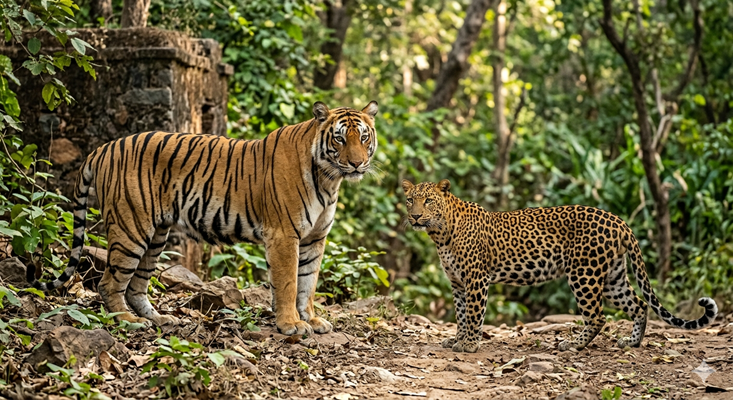
Two of nature’s most magnificent predators — one the world’s largest cat, the other its most adaptable. A detailed head-to-head comparison of the tiger and the leopard across size, speed, habitat, hunting, and survival
Introduction: Giants and Ghosts of the Animal Kingdom
If the animal kingdom were to hold a competition for the title of most iconic predator, the tiger and the leopard would both be strong contenders. The tiger commands attention — massive, bold, and unmistakable with its blazing orange coat and black stripes. The leopard earns respect through something quieter: a near-supernatural ability to vanish into any landscape, to kill without being seen, and to survive where almost every other large predator has disappeared.
They share the same genus — Panthera — and the same essential biology. Both are solitary ambush hunters. Both are apex predators in their respective ecosystems. Both carry coat patterns as unique as fingerprints. And both are in serious trouble, threatened by the same forces of habitat destruction, human conflict, and poaching that are reshaping the natural world.
Yet in almost every other respect, the tiger and the leopard are a study in contrast. Size versus stealth. Power versus adaptability. Endangered versus resilient. This article explores all of it — putting these two magnificent animals side by side to understand what makes each of them extraordinary, and what the future holds for both.
At a Glance: Key Facts Side by Side
| Feature | Tiger | Leopard |
|---|---|---|
| Scientific Name | Panthera tigris | Panthera pardus |
| IUCN Status | Endangered | Vulnerable |
| Adult Male Weight | 100–306 kg (up to 660 lb) | 37–90 kg (up to 200 lb) |
| Body Length | Up to 3.7 m (12 ft) including tail | Up to 2.5 m (8 ft) including tail |
| Coat Pattern | Orange/white with black stripes | Tawny/gold with black rosette spots |
| Top Speed | ~50–65 km/h (short bursts) | ~58 km/h (short bursts) |
| Climbing Ability | Limited — too heavy for most trees | Exceptional — regularly hauls kills up trees |
| Swimming Ability | Excellent — actively seeks water | Capable but less enthusiastic |
| Primary Habitat | Dense forest, grasslands, mangroves | Forest, savannah, mountains, desert, urban fringe |
| Range | Asia only (10 countries) | Africa and Asia (widest range of any wild cat) |
| No. of Subspecies | 6 living (2 in modern taxonomy) | 9 recognised |
| Wild Population | Approx. 3,700–5,578 | No reliable global count; declining |
| Social Structure | Solitary (except mothers with cubs) | Solitary (except mothers with cubs) |
| Activity Pattern | Mostly nocturnal/crepuscular | Mostly nocturnal; diurnal in some areas |
| Gestation Period | 93–111 days | 90–105 days |
| Lifespan (Wild) | 10–15 years | 10–15 years |
1. Taxonomy and Evolutionary History
Both the tiger and the leopard belong to the genus Panthera — the group of true big cats defined by their unique ability to roar. A 2010 study published in Molecular Phylogenetics and Evolution revealed that the snow leopard and the tiger are sister species, while the lion, leopard, and jaguar are more closely related to each other. The tiger and snow leopard diverged from the ancestral big cats approximately 3.9 million years ago. The tiger then evolved into a unique species towards the end of the Pliocene epoch, approximately 3.2 million years ago. Lions and leopards split from one another approximately 2 million years ago.
This means that, despite sharing the same genus, the tiger is actually more distantly related to the leopard than the leopard is to the lion and jaguar. They share a common ancestor but have been evolving along separate lines for millions of years — long enough to develop dramatically different body plans, behaviours, and ecological roles.
The tiger (Panthera tigris) evolved as a forest specialist in Asia, growing to enormous size in habitats where large prey like deer, wild boar, and buffalo were abundant. The leopard (Panthera pardus) evolved as a generalist across Africa and Asia — smaller, faster, more flexible, and suited to a far wider range of conditions.
2. Physical Appearance: Stripes Versus Spots
The most immediately obvious difference between the tiger and the leopard is their coat. The distinction could not be more stark.
Tigers are the only cats with stripes, featuring a reddish-orange to yellow-ochre coat with black stripes and a white underside. Stripe patterns are unique to each individual, varying in number, width, and whether they split or form spots. In the dense forest undergrowth where tigers typically hunt, vertical stripes break up the outline of the body and mimic the play of light and shadow through tall grass and bamboo — making a 300 kg animal surprisingly difficult to spot.
The leopard, by contrast, wears a coat of rosettes — circular clusters of black spots arranged around a slightly darker centre, against a background of tawny gold or pale cream. Like tiger stripes, every rosette pattern is unique to each individual. The leopard’s spotted coat provides camouflage across an extraordinary range of environments, from the dappled shade of tropical forests to the dry scrub of African savannahs and the rocky slopes of Central Asian mountains.
Both species can produce melanistic individuals — animals with an excess of dark pigmentation that gives them an almost entirely black coat. In tigers, this is exceptionally rare. In leopards, melanistic individuals — commonly called black panthers — occur more frequently, particularly in dense forest environments in Asia where darker colouring provides a hunting advantage. White tigers, by contrast, are caused by a rare genetic mutation affecting pigmentation and have not been reliably recorded in the wild for over 50 years.
Size: There Is No Contest
Tigers are the largest of all the Asian big cats. Males of the larger subspecies, the continental tiger, may weigh up to 660 pounds (300 kg). The tiger is the largest living cat species, although large lions can exceed smaller tigers in size.
The leopard, by comparison, is the smallest of the five true big cats. Leopards are about 4 to 7 feet long and weigh up to about 90 kg. They have a slender body with short, stocky legs and a long tail, making them excellent and agile hunters.
Put simply: the largest tigers are three to four times heavier than the largest leopards. A Bengal or Amur tiger is simply in a different physical category — one of the most powerful land animals on Earth. Yet this size difference tells only part of the story. The leopard’s smaller, more compact body enables it to do things no tiger can — and its survival record speaks for itself.
3. Habitat: Where Each Cat Calls Home
The Tiger: A Forest Specialist
Tigers rely primarily on sight and sound rather than smell for hunting and are found in tropical rainforests, evergreen forests, temperate forests, mangrove swamps, grasslands, and savannas across Asia. Different subspecies have adapted to radically different environments — from the hot, humid rainforests of Sumatra to the frozen taiga forests of the Russian Far East, where Amur tigers have evolved thick, pale coats to cope with temperatures that can drop below minus 40 degrees Celsius.
Tigers need large territories. Individual tigers have a large territory, and the size is determined mostly by the availability of prey. To protect just one tiger, we have to conserve an estimated 10,000 hectares of forest. This enormous space requirement is one of the key reasons tiger conservation is so challenging — it demands large, connected forest landscapes that are increasingly difficult to maintain in densely populated Asia.
Tigers are now confined to ten countries: Bangladesh, Bhutan, China, India, Indonesia, Malaysia, Myanmar, Nepal, Russia, and Thailand.
The Leopard: The Adaptable Survivor
If the tiger is a specialist, the leopard is the ultimate generalist. It is found across a greater geographic range than any other wild cat on Earth — from the sub-Saharan savannahs of Africa to the mountain ranges of Central Asia, the rainforests of Southeast Asia, and the scrub jungles of Sri Lanka.
Leopards inhabit various types of areas including rainforests, deserts, mountains, and grasslands. Certain subspecies are considered as threatened species, mainly due to the loss of their natural habitats. Some leopard populations have even been documented living in the fringes of major cities, hunting in urban green spaces under the cover of darkness — a flexibility no tiger could manage.
This adaptability is the leopard’s greatest survival asset. Where the tiger requires intact, prey-rich forest of enormous extent, the leopard can eke out an existence in fragmented, degraded habitats that larger predators cannot tolerate. It is this quality more than any other that has allowed the leopard to persist in regions where the tiger has long since disappeared.
4. Hunting: Power Versus Precision
The Tiger: Brute Force and Patience
The tiger is an ambush predator of extraordinary power. Tigers typically hunt alone and stalk prey. A tiger can consume more than 80 pounds of meat at one time. Unlike the cheetah, which relies on speed, or the wolf, which relies on endurance, the tiger uses stealth and explosive strength — stalking to within striking distance before launching a sudden, devastating charge.
A tiger only eats once a week, but they eat a lot — up to seventy-five pounds in one sitting. This feast-and-fast pattern reflects the enormous energy cost of both the hunt itself and the tiger’s massive body. Between kills, tigers rest extensively, conserving energy for the next hunt.
Tigers are also remarkable swimmers. Unlike most cats, they actively seek out water — cooling themselves in rivers and lakes and readily swimming across wide bodies of water in pursuit of prey or new territory. This aquatic confidence gives them access to habitats, like the mangrove swamps of the Sundarbans in India and Bangladesh, that would be inaccessible to many other predators.
The tiger’s preferred prey varies by subspecies and region — sambar and chital deer, wild boar, gaur, and water buffalo are all common targets. Larger prey like young elephants and rhinos have occasionally been taken, though such events are unusual. Tigers have also been known to prey on other creatures, like monkeys, leopards, and even crocodiles. In areas where tigers and leopards share territory, the tiger is a direct threat to the smaller cat — and the leopard knows it.
The Leopard: The Master of Stealth
The leopard hunts very differently. Where the tiger overwhelms with power, the leopard relies on invisibility, patience, and precise execution. The leopard relies on stealth and ambush to capture prey. Leopards can climb tall trees while dragging a fully grown antelope that weighs much more than they do.
The leopard’s hunting technique is a masterclass in economy of effort. It will stalk its quarry for long periods — sometimes an hour or more — closing the distance centimetre by centimetre before launching a final, explosive sprint. The kill is delivered with a precise bite to the throat, cutting off the airway and blood supply simultaneously. The whole process is surgical in its efficiency.
One of the most iconic leopard behaviours is caching kills in trees. In areas where lions, hyenas, and wild dogs compete for food, a leopard that leaves its kill on the ground will quickly lose it to a larger, stronger competitor. Leopards are known for not being able to change their spots, but what is even more impressive is that pound for pound, the leopard is the strongest climber of the larger cats. A leopard can haul prey two to three times its own body weight straight up a vertical tree trunk — a feat of raw strength that even the tiger cannot match in proportion to body size.
Leopards are incredibly strong and possess immense agility, capable of leaping horizontally up to 6 metres and vertically up to 3 metres, allowing them to ambush their prey from above with precision. Unlike most other large cats, leopards are also skilled swimmers and readily take to water when needed.
5. Speed and Agility
Both animals are fast — but in different ways and for different purposes.
The tiger’s top speed is estimated at around 50 to 65 km/h over short distances. Given its enormous bulk, this is genuinely impressive. However, the tiger relies on closing distance quickly from a short stalking position rather than sustained pursuit — its large body overheats rapidly during sustained running, and it lacks the long legs and flexible spine of a cheetah built for open-country sprinting.
The leopard achieves a comparable or slightly higher top speed of around 58 km/h, and its more compact, athletic body makes it significantly more manoeuvrable. The leopard can change direction at high speed, accelerate and decelerate rapidly, and navigate dense vegetation with ease — qualities that serve an ambush predator perfectly. It can also leap enormous distances both horizontally and vertically, allowing it to clear obstacles and launch attacks from elevated positions.
In terms of raw agility, the leopard has a clear edge. Its combination of speed, climbing ability, leaping power, and manoeuvrability makes it one of the most athletically complete predators in the animal kingdom — all in a package that weighs less than a large Labrador retriever compared to the tiger.
6. Diet and Prey
Both the tiger and the leopard are obligate carnivores — they must eat meat to survive — but their dietary ranges reflect their very different sizes and ecological positions.
The tiger targets large ungulates. Sambar deer, chital, wild boar, gaur, and water buffalo are the mainstays across most of its range. Given its body weight, the tiger needs to kill regularly and substantially — a single large deer may barely sustain a big male for a few days. Tigers rarely eat small prey like rodents or birds — the energy return simply does not justify the effort for an animal of their size.
The leopard, by contrast, has one of the most diverse diets of any large carnivore. It eats impala, gazelle, reedbuck, and other medium-sized antelope across Africa. It also takes baboons, warthogs, hares, birds, fish, insects, and reptiles. It can survive on remarkably small prey when necessary — a quality that becomes crucial when larger prey is scarce. This dietary flexibility is a direct extension of its habitat flexibility, and it is one of the key reasons the leopard has outlasted the tiger across much of their formerly shared range in Asia.
7. Social Structure and Behaviour
In both species, the fundamental social structure is the same: solitary, territorial, and largely nocturnal. Both are polygynandrous — males and females mate with multiple partners, and males play no role in raising cubs. Both communicate through scent marking, vocalisation, and scratch marks on trees.
Tigers are mostly solitary, apart from associations between mother and offspring. Individual tigers mark their domain with urine, feces, rakes, scrapes, and vocalizing. Male territories are large and typically overlap with those of several females.
The leopard follows the same pattern, though its territories are generally smaller — reflecting its more modest space requirements and the wider range of habitats it can exploit. In areas where prey is abundant, leopard densities can be remarkably high. Yala National Park in Sri Lanka, for instance, boasts one of the highest recorded leopard densities in the world.
One notable behavioural difference is daytime activity. In areas where tigers are the dominant predator, leopards become almost exclusively nocturnal, actively avoiding confrontation. Where no tigers are present — as in Sri Lanka, where the leopard is the sole apex predator — leopards are commonly observed hunting and moving during daylight hours. The tiger’s presence, in other words, directly shapes leopard behaviour wherever the two animals share territory.
Tigers give birth to two to four cubs every two years. Juvenile mortality is high, with about half of all cubs not surviving more than two years. Tigers generally gain independence at around two years of age and attain sexual maturity at age three or four for females and four or five years for males. Leopard cubs follow a similar developmental trajectory, typically remaining with their mother for 18 to 24 months before dispersing.
8. Subspecies: A Divided Family
Tiger Subspecies
Traditionally, the modern tiger was considered to comprise six extant and three extinct subspecies. The six living subspecies are: the Amur or Siberian tiger, the South China tiger (likely extinct in the wild), the Northern Indochinese tiger, the Malayan tiger, the Sumatran tiger, and the Bengal tiger. Recent genetic studies, however, propose only two subspecies: Panthera tigris tigris (mainland Asia) and Panthera tigris sondaica (Sumatra and formerly Java and Bali). The taxonomy is currently under review.
Three tiger subspecies have already gone extinct in modern times. The Balinese, Caspian, and Javan tigers have been officially confirmed as extinct. The South China tiger is possibly extinct in the wild, as there have been no confirmed wild sightings since the 1970s.
At the beginning of the 20th century, the world’s tiger population was estimated at 100,000. As the century drew to a close, only 5,000 to 7,500 were left in the wild. Since then, the world’s tiger population declined further, before beginning to recover thanks to conservation intervention. By 2023, the Global Tiger Forum reported approximately 5,574 wild tigers, reflecting a remarkable 74% increase since the TX2 initiative, which aimed to double wild tiger numbers from the 2010 baseline by 2022. This recovery is one of the most celebrated conservation success stories of recent decades — though the species remains Endangered and fragile.
Leopard Subspecies
The leopard has nine recognised subspecies, spread across Africa and Asia. They range from the widespread African leopard — found across most of sub-Saharan Africa — to the Critically Endangered Amur leopard of the Russian Far East, with only around 130 individuals surviving in the wild.
Other subspecies include the Indian leopard, Persian leopard, Arabian leopard, Javan leopard, Indochinese leopard, North Chinese leopard, and the Sri Lankan leopard — the only subspecies endemic to a single island, and the only large predator found on Sri Lanka. Together, the nine subspecies represent the extraordinary range of environments the leopard has conquered — from the Siberian snow to the Arabian desert to the tropical jungles of Java.
9. Conservation Status: Two Different Stories
The Tiger: Endangered but Recovering
The tiger is listed as Endangered on the IUCN Red List — one step more serious than the leopard’s Vulnerable status. The most recent IUCN Red List assessment estimates there are between 3,726 and 5,578 tigers left in the wild, with only about 3,140 mature individuals. Some countries — like India, Nepal, Bhutan, and Thailand — have seen increases in local tiger numbers thanks to stronger protections and focused recovery programs. But others, particularly in Southeast Asia, have experienced devastating declines. Tigers have already disappeared from Cambodia, Vietnam, and Laos.
The key threats to tiger survival are habitat loss and fragmentation as forests are cleared for agriculture and development, poaching for skins and body parts used in traditional medicine, and the depletion of prey populations. Tiger occupancy has declined by 53% since 1997, which scientists have primarily attributed to illegal poaching. Tiger body parts are highly sought after by illegal traders.
India is the stronghold of global tiger conservation. Home to more than 3,600 wild tigers — over half the world’s total — India’s Project Tiger, launched in 1973, is widely regarded as one of the most successful large carnivore conservation programmes ever implemented. It has been the model for the International Big Cat Alliance, launched in 2023 to extend similar conservation frameworks globally.
The Leopard: Vulnerable but Widespread
The leopard is listed as Vulnerable globally — a less immediately alarming status than the tiger’s Endangered designation. But this headline figure conceals a more complex and in some places desperately serious picture. Leopards have lost approximately 75% of their historic global range. Three subspecies — the Amur, Arabian, and Indochinese — are Critically Endangered. Several others face rapid decline.
The leopard’s relative resilience compared to the tiger reflects its adaptability. It can survive in smaller territories, on a wider range of prey, in more fragmented habitats, and closer to human populations. These qualities have bought it time that the tiger does not have. But they have not made it immune to the same forces — habitat loss, poaching, prey depletion, and human-wildlife conflict are threatening the leopard across its range, even if the species as a whole has not yet reached the level of crisis the tiger has endured.
10. Cultural Significance: Reverence Across Continents
Both the tiger and the leopard have been revered, feared, and mythologised by human cultures across thousands of years and dozens of civilisations.
The tiger is the national animal of India, Bangladesh, Malaysia, Myanmar, and South Korea. It appears in the flags, emblems, and cultural identities of nations from China to Indonesia. In Hindu mythology, the goddess Durga rides a tiger as a symbol of divine power and protection. In Chinese culture, the tiger is one of the twelve zodiac animals and represents strength, bravery, and authority. Tigers are the most common symbol in Asian martial arts and are depicted on the shields and crests of countless dynasties and kingdoms throughout history.
The leopard carries equally deep cultural weight. Across sub-Saharan Africa, the leopard has been associated with royalty, power, and the spirit world for millennia — leopard skins were worn by kings, warriors, and priests as symbols of authority and supernatural connection. The leopard appears in the heraldry of dozens of nations, particularly in Africa. In Sri Lanka, the kotiya is revered as a forest guardian and apex icon of the island’s wild places. In ancient Egypt, leopard skins were worn by priests in funerary ceremonies. Across the world, the leopard’s spotted coat has inspired art, fashion, jewellery, and design across every era of human history.
Summary: Who Has the Edge?
Biggest and most powerful: Tiger, without question. The Amur tiger is the largest cat that has ever lived. One swipe of its paw contains forces that no leopard could match.
Most adaptable and widespread: Leopard. It is found across a greater range of habitats, countries, and altitudes than any other wild cat on Earth.
Best climber: Leopard. It regularly hauls prey heavier than itself into trees — a feat no tiger attempts.
Best swimmer: Tiger. It actively seeks out water and swims across wide rivers with ease.
Most diverse diet: Leopard. It can survive on prey ranging from insects and frogs to large antelopes.
Easier to observe in the wild: Depends on location. In India’s national parks, tiger sightings are reasonably accessible. The Sri Lankan leopard, with its daytime activity and high park densities, offers some of the most reliable big cat sightings in the world.
Greater conservation concern: Tiger — Endangered versus the leopard’s Vulnerable status globally. However, several leopard subspecies are Critically Endangered and in far more immediate peril than the species-level classification suggests.
Conclusion: Complementary Icons of the Wild
The tiger and the leopard are not rivals for the title of greatest cat — they are complementary expressions of what the Panthera genus can achieve. One went big, bold, and specialised, becoming the most powerful land predator in Asia. The other stayed lean, flexible, and invisible, spreading across two continents and outlasting every competitor. Both approaches have worked brilliantly — and both are now under threat from the same source.
Losing the tiger would remove one of the most magnificent animals ever to walk the Earth — a creature of pure, awe-inspiring power. Losing the leopard would remove the most successful and widespread big cat in history — the animal that proved that adaptability is the ultimate survival strategy. Neither loss is acceptable. Both species urgently need the habitat protection, anti-poaching enforcement, and community engagement that conservation programmes around the world are working to provide.
To support tiger conservation, visit WWF’s Tiger Programme and India’s National Tiger Conservation Authority. To support leopard conservation, visit Panthera’s Leopard Programme and, for the Sri Lankan leopard specifically, the Wilderness and Wildlife Conservation Trust.
References and Further Reading
- IUCN Cat Specialist Group. Living Species — Tiger (Panthera tigris). IUCN Red List Version 2024-2.
- IUCN Red List. Panthera pardus — Leopard Species Assessment. 2024.
- World Wildlife Fund. Tiger Species Profile.
- World Wildlife Fund. Leopard Species Profile.
- Britannica. Tiger — Conservation, Habitat, Endangered.
- IFAW. Continental Tigers: Facts, Threats and Conservation.
- San Diego Zoo Wildlife Alliance Library. Tiger (Panthera tigris) Fact Sheet — Population and Conservation Status.
- A-Z Animals. Leopard vs Tiger: Comparing the Big Cat Contenders.
- Humane World for Animals. Why Tigers Are Still Endangered in 2025.
- Global Tiger Forum / WWF. TX2 Initiative — Doubling Wild Tigers by 2022. 2023 results report.
- Wikipedia. Tiger (Panthera tigris).
- Wikipedia. Leopard (Panthera pardus).
Leave a comment: