
- 19 Views
- 9 Min Read
- (0) Comment
Introduction: The Reign of the Big Cats
Few creatures on Earth command as much awe as the big cats. They are the apex hunters of their ecosystems — built for speed, power, stealth, and survival. From the snow-dusted mountains of Central Asia to the sun-baked savannahs of Africa, big cats have shaped the natural world for millions of years. They sit at the very top of food chains, regulate prey populations, and have embedded themselves deeply into human culture, mythology, and imagination.
But what exactly is a “big cat”? The answer is more complicated than most people realise, and it has been debated by scientists for centuries.
So What Actually Makes a Cat a “Big Cat”?
The confusion around this term is real — and worth explaining properly, because it directly affects where the cheetah and cougar fit into this story.
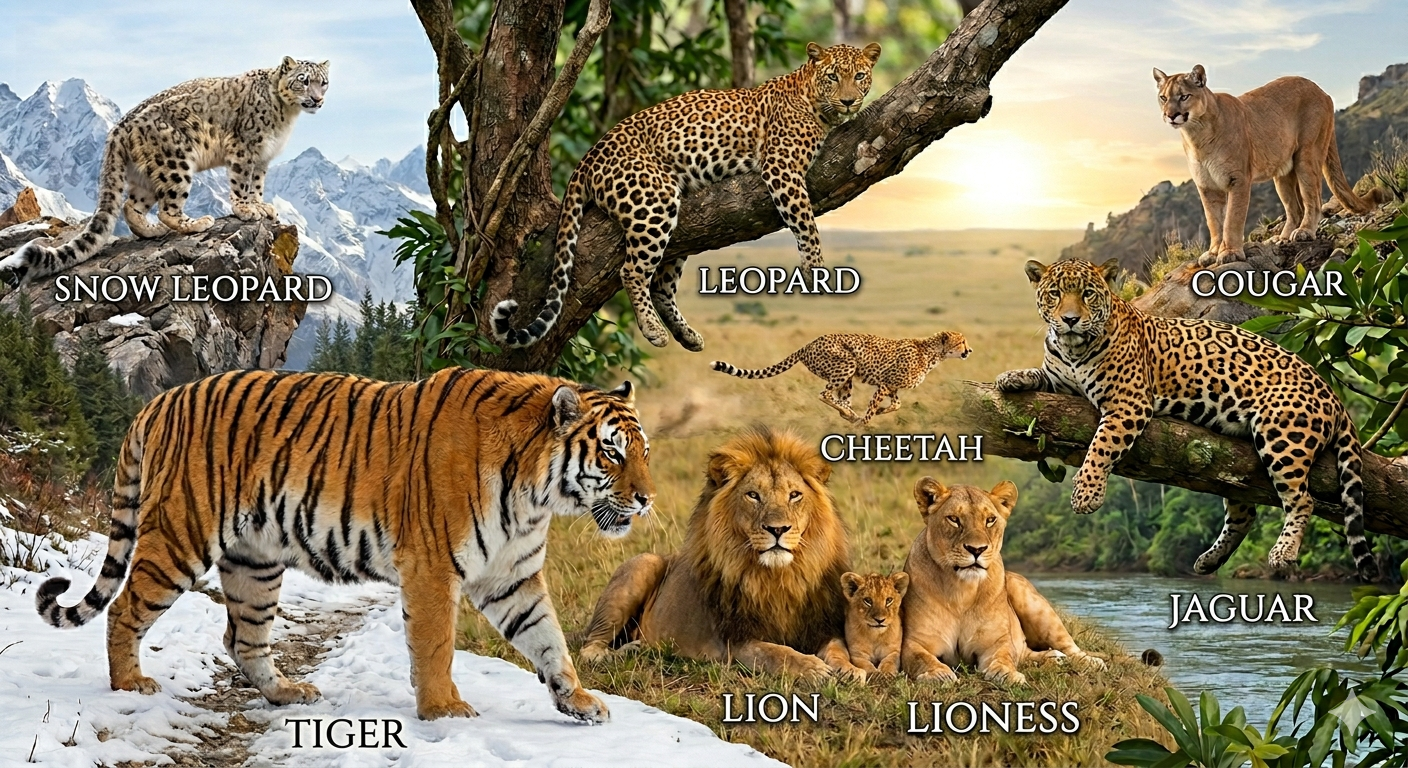
In its strictest scientific sense, “big cat” refers to the five members of the genus Panthera: the lion, tiger, jaguar, leopard, and snow leopard. The feature that distinguishes the true big cats from the rest of the cat family is their ability to roar, because they have a floating hyoid bone and a specially adapted larynx. This anatomical trait is what has traditionally defined the group.
Unlike cheetahs and cougars, true big cats have tough cartilage running from their hyoid bones to their skulls, which prevents purring but enables them to roar (IFAW).
However, the definition has never been fully settled. Since their establishment in 2006, Panthera — one of the world’s leading wild cat conservation organisations — has classified seven big cat species based on their similar size and ecology: tigers, lions, jaguars, leopards, snow leopards, pumas, and cheetahs.
So in popular usage, the cheetah and cougar are widely accepted as big cats. In strict scientific taxonomy, they are not — they belong to the subfamily Felinae rather than Pantherinae. For the purposes of this article, we will cover all seven, explaining clearly what makes each one unique and where they truly belong.
THE FIVE TRUE BIG CATS (Genus Panthera)
The Tiger (Panthera tigris)
The tiger is the largest of all wild cats and one of the most iconic animals on Earth. A fully grown Bengal tiger can weigh over 300 kg and measure more than 3 metres from nose to tail. Tigers are solitary, territorial animals and powerful swimmers. They are native to Asia, with surviving populations ranging from the Russian Far East to the Indian subcontinent and Southeast Asia.
Tigers are classified as Endangered globally. There are six surviving subspecies, including the Bengal, Amur, and Sumatran tigers. The Balinese, Caspian, and Javan tigers all went extinct in the 20th century. Fewer than 4,000 tigers are believed to remain in the wild.
The Lion (Panthera leo)
The lion is the only truly social big cat. Lions live in groups called prides, composed of related females, their cubs, and a coalition of males. This social structure makes them unique among the Panthera family. Lions are built for cooperative hunting on open grasslands, and their iconic roar can carry up to 8 kilometres across open terrain.
Historically, lions ranged across Africa, southern Europe, and much of Asia. Today they are largely confined to sub-Saharan Africa, with a small, critically endangered population — the Asiatic lion — surviving in the Gir Forest of India. Global tracking estimates indicate that only about 20,000 mature lions remain in the wild across Africa (Bauer et al., 2015). African lions are classified as Vulnerable.
The Jaguar (Panthera onca)
The jaguar is the largest cat in the Americas and the third largest in the world. Stocky, muscular, and immensely powerful, jaguars have a broader head and stronger bite than leopards — capable of crushing turtle shells and piercing caiman skulls. They are found from the southwestern United States through Central America and into South America, with the Amazon Basin as their stronghold.
Like leopards, jaguars have rosette-patterned coats, but jaguar rosettes typically contain small spots inside them — a key visual distinction. Spatial density models place the global jaguar population at roughly 173,000 individuals, heavily concentrated within the dense foliage of the Amazon Basin (Jędrzejewski et al., 2018). Jaguars are classified as Near Threatened.
The Snow Leopard (Panthera uncia)
The snow leopard is among the most elusive animals on Earth. Native to the high-altitude mountain ranges of Central and South Asia — including the Himalayas, the Tibetan Plateau, and the Altai Mountains — the snow leopard is perfectly adapted for extreme cold and rugged terrain.
Even though the snow leopard belongs to Panthera, its vocal anatomy is different and it cannot produce a true roar. Instead, it makes sounds such as chuffing, growling, and yowling. Snow leopards are classified as Vulnerable, with an estimated 4,000 to 6,500 individuals remaining across 12 countries.
The Leopard (Panthera pardus)
The leopard is the smallest of the five true big cats, yet arguably the most successful. It has the widest geographic range of any wild cat, having survived across sub-Saharan Africa, North Africa, the Middle East, Central Asia, South Asia, and Southeast Asia. Pound for pound, the leopard is the strongest climber among the big cats, regularly hauling prey heavier than itself up into trees.
Globally, the leopard is classified as Vulnerable on the IUCN Red List. Population estimates for leopards are highly elusive due to their nocturnal and secretive nature, though studies map their historical range loss alongside localized trackings (Jacobson et al., 2016). Modern estimates put their remaining wild numbers around several hundred thousand across Africa and Asia, though specific subspecies (like the Amur leopard) numbers have crashed to fewer than 100 individuals.
THE “BROADER” BIG CATS — Large, Powerful, but Outside Panthera
The Cheetah (Acinonyx jubatus) — Built for Pure Speed
Is it a big cat? Technically, no — but widely treated as one.
The cheetah is the only remaining species of the genus Acinonyx. It does not have the roaring adaptation and instead makes a chirping sound and can purr — more like a domestic cat than a lion. It belongs to the subfamily Felinae, not Pantherinae.
That said, the cheetah is one of the most remarkable cats on Earth. It is the fastest land animal, capable of running at 93–104 km/h, with powerful hindlimb muscles, long limbs, and a flexible spine built entirely for speed. At top speed, a cheetah covers 7 metres in a single stride. It can accelerate from 0 to 72 km/h in just 2.5 seconds — no other land mammal comes close.
Unlike other big cats, the cheetah hunts entirely by sight during daylight hours. Its distinctive black tear-stripe markings running from eye to mouth are believed to reduce sun glare, helping it focus on prey across open plains. However, this speed comes at a price — a sprint can only be maintained for a few hundred metres before the cheetah overheats, and the majority of hunts end in failure.
The cheetah is found primarily in the open savannahs and grasslands of eastern and southern Africa. A tiny and critically endangered Asiatic population survives in Iran. Over the past 50 years, cheetahs have gone extinct in at least 13 countries. The IUCN Red List classifies the cheetah as Vulnerable, with fewer than 7,000 individuals remaining in the wild. Habitat loss, prey depletion, the illegal pet trade, and human-wildlife conflict are the primary threats.
The cheetah’s unusually low genetic diversity — the result of ancient population bottlenecks during the last Ice Age — makes the species especially fragile in the face of disease and environmental change.
The Cougar / Puma / Mountain Lion (Puma concolor) — The Cat of Many Names
Is it a big cat? Technically, no — but it is one of the largest and most widespread wild cats on Earth.
Puma, cougar, mountain lion, catamount, and panther all refer to the same animal: Puma concolor. It holds a Guinness World Record for the animal with the most common names in the English language. Like the cheetah, it belongs to the subfamily Felinae and cannot roar.
The cougar inhabits North, Central, and South America, making it the most widely distributed wild terrestrial mammal in the Western Hemisphere. Its range spans from Canada’s Yukon all the way to the southern tip of Patagonia. Adult males typically weigh between 52 and 100 kg, making the largest individuals comparable in size to a leopard.
The cougar is an adaptable generalist, found in deserts, tropical rainforests, mountain ranges, grasslands, and even on the edges of major cities like Los Angeles. It is a keystone species in Western Hemisphere ecosystems, interacting with 485 other species through predation, competition, and the food it leaves behind.
Globally, the cougar is listed as Least Concern by the IUCN — making it the most stable of all the large cats in this article. However, the picture is uneven. The eastern cougar subspecies was declared officially extinct in 2011. The Florida panther subspecies is Endangered, with only around 200 individuals remaining. Across North America, an estimated 30,000 cougars survive today, down dramatically from historic numbers. Habitat loss, fragmentation by highways, and retaliatory killings remain serious threats.
Big Cats Summary Reference Table
| Name | Global Distribution | Numbers (Estimated Wild Population) | Size / Weight Range (Adults) | Conservation Status (IUCN) |
| Tiger (Panthera tigris) | Asia (Russian Far East, India, Southeast Asia) | Fewer than 4,000 |
100 – 310 kg (220 – 680 lbs) (Males significantly larger than females) |
Endangered |
| Lion (Panthera leo) | Sub-Saharan Africa (with ~600 individuals in Gir Forest, India) | ~20,000 |
120 – 250 kg (265 – 550 lbs) (Males: 190-250kg | Females: 120-180kg) |
Vulnerable (Asiatic population is Critically Endangered) |
| Jaguar (Panthera onca) | The Americas (Southwestern US to South America) | ~173,000 |
56 – 100 kg (123 – 220 lbs) (Exceptional males can exceed 130 kg) |
Near Threatened |
| Snow Leopard (Panthera uncia) | High-altitude mountain ranges of Central and South Asia | 4,000 to 6,500 | 30 – 55 kg (66 – 121 lbs) | Vulnerable |
| Leopard (Panthera pardus) | Sub-Saharan Africa, North Africa, Middle East, Asia | ~250,000+ (Highly variable) |
28 – 90 kg (62 – 200 lbs) (Pound-for-pound the strongest climber) |
Vulnerable |
| Cheetah (Acinonyx jubatus) | Primarily eastern and southern Africa (tiny population in Iran) | Fewer than 7,000 |
35 – 65 kg (77 – 143 lbs) (Built lean for aerodynamics and speed) |
Vulnerable (Asiatic population is Critically Endangered) |
| Cougar / Puma (Puma concolor) | North, Central, and South America (Yukon to Patagonia) | ~30,000 in North America |
36 – 100 kg (80 – 220 lbs) (Large males are comparable to leopards) |
Least Concern (Florida panther subspecies is Endangered) |
References
Bauer, H., Chapron, G., Nowell, K., Henschel, P., Funston, P., Hunter, L. T. B., Macdonald, D. W., & Packer, C. (2015). Lion (Panthera leo) populations are declining rapidly across Africa, except in intensively managed areas. Proceedings of the National Academy of Sciences, 112(48), 14894-14899. https://doi.org/10.1073/pnas.1500664112
Cited by: 425
Jacobson, A. P., Gerngross, P., Lemeris Jr., J. R., Schoonover, R. F., Anco, C., Breitenmoser-Würsten, C., Durant, S. M., Farhadinia, M. S., Henschel, P., Kamler, J. F., Laguardia, A., Rostro-García, S., Stein, A. B., & Dollar, L. (2016). Leopard (Panthera pardus) status, distribution, and the research efforts across its range. PeerJ, 4, e1974. https://doi.org/10.7717/peerj.1974
Cited by: 455
Jędrzejewski, W., Robinson, H S., Abarca, M., Zeller, K. A., Velasquez, G., Paemelaere, E. A. D., Goldberg, J. F., Payan, E., Hoogesteijn, R., Boede, E. O., Schmidt, K., Lampo, M., Viloria, Á. L., Carreño, R., Robinson, N., Lukacs, P. M., Nowak, J. J., Salom-Pérez, R., Castañeda, F., Boron, V., & Quigley, H. (2018). Estimating large carnivore populations at global scale based on spatial predictions of density and distribution – Application to the jaguar (Panthera onca). PLOS ONE, 13(3), e0194719. https://doi.org/10.1371/journal.pone.0194719
Cited by: 162
Leave a comment: